

The easiest way to waste money in performance marketing is to treat the click as the finish line.
I have spent much of my career looking at what happens after that click. Since I started working in digital marketing in 2006, I have completed more than 650 CRO audits across 14 countries, worked with acquisition teams, designers, developers and business owners, and repeatedly seen the same pattern: a campaign can look weak when the real problem sits somewhere else in the conversion path.
Sometimes the ad is fine and the landing page is slow. Sometimes the targeting is reasonable but the offer is vague. Sometimes leads are inexpensive but the follow-up process is poor. Sometimes a company is celebrating a healthy cost per lead while the sales team quietly tells a very different story.
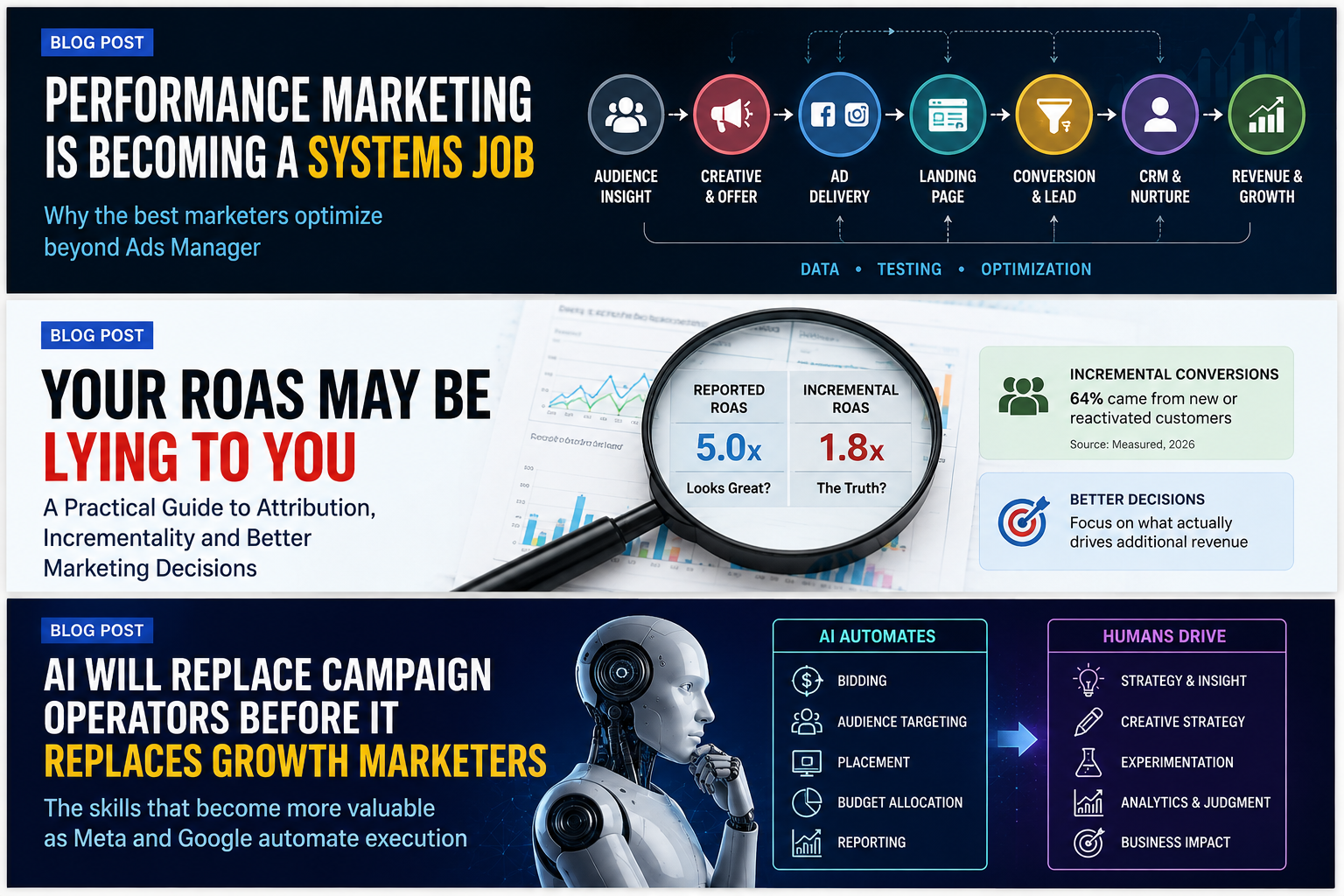
Performance marketing is no longer a channel job. It is becoming a systems job
Table of Contents
The platforms are automating more of the media buying
This shift is not theoretical. Meta and Google are steadily automating tasks that once required a large amount of hands-on campaign management.
Meta’s January 2026 advertising update describes stronger AI-powered ad ranking, creative tools and optimization. Meta reported that its newer ranking systems improved ad clicks on Facebook and conversions on Instagram during Q4 2025. The important point for marketers is not the exact percentage. It is the direction of travel: the platform is getting better at deciding who should see which ad.
Google is moving in the same direction with AI Max. In August 2026, Google announced additional testing and planning tools that let advertisers test budgets and ROI targets across multiple Search campaigns and apply AI-driven planning recommendations more directly.
If platforms become better at bidding, matching, placement and delivery, then the marketer’s advantage moves to the inputs the platform cannot fully own: understanding the customer, deciding what to say, building the offer, shaping the conversion experience, validating the measurement and deciding where the next dollar should go.
The real performance marketing funnel
I prefer to think about paid media as one part of a larger revenue system:
- Customer insight: Who are we trying to influence, and what problem are they trying to solve?
- Creative and message: What angle, proof, objection or outcome earns attention?
- Media delivery: Where do we reach the prospect, and how efficiently can we buy that attention?
- Landing experience: Does the page continue the promise made in the ad, or does the message break?
- Conversion mechanism: Is the form, call, checkout or booking process easy enough to complete?
- Follow-up: What happens after the lead or purchase? Is there automation, a sales response, remarketing or lifecycle communication?
- Measurement: Are we looking at the right business outcome, or only the easiest platform metric to report?
When marketers optimize only the third step, they are managing traffic. When they understand all seven, they are managing growth.
Why creative is now a performance variable, not a design task
Jon Loomer’s explanation of Meta’s creative diversification shift is useful because it captures what many experienced Meta advertisers are seeing. The platform increasingly wants advertisers to provide meaningfully different creative angles, formats and personas rather than relying on narrow audience controls.
That changes the relationship between paid media and customer research. A performance marketer cannot simply ask the design team for ten more ads. The better question is: what ten different reasons might cause different buyers to care?
A testimonial, a product demonstration, a risk-reversal message, a before-and-after story and an objection-handling ad are not merely creative variations. They are different hypotheses about what motivates the customer.
That is where CRO thinking becomes valuable inside performance marketing. A good CRO practitioner is trained to ask what reduces anxiety, what increases clarity, what creates friction and what evidence helps a user move forward. Those same questions now influence ad creative as much as landing pages.
A strong ad can be made to look weak by a poor landing page
This is one of the most common mistakes I see when teams evaluate paid campaigns. They look at the ad account, see an expensive CPA and immediately change the audience, budget or creative.
Before doing that, I want to know what happens after the click.
Does the landing page load quickly on the devices producing most of the traffic? Does the headline repeat the promise that generated the click? Does the page explain the value proposition in a few seconds? Is the form unnecessarily long? Are important trust signals missing? Does the page make the visitor search for information that should have been obvious?
These are not cosmetic questions. They affect the economics of the campaign.
Imagine two advertisers buying the same quality of traffic at the same cost. One landing page converts 3% and the other converts 6%. The second business can tolerate a much higher CPC and still produce a better acquisition cost. That is why CRO and media buying should not be managed as separate disciplines.
The metric should follow the business model
A lead-generation company should not stop at cost per lead. It should understand contact rate, qualified lead rate, booked appointment rate, close rate and revenue per lead.
An ecommerce company should not stop at ROAS. It should understand new-customer acquisition cost, contribution margin, average order value, repeat purchase behavior and how much of the revenue was actually incremental.
A SaaS company should not stop at trial signups. It should know activation, paid conversion, retention and customer lifetime value.
The performance marketer has to connect platform metrics to business economics. CTR, CPM and CPC are diagnostic metrics. They can help explain what is happening. They are not the final objective.
What I would expect from a modern performance marketer
If I were building a performance team today, I would look for five capabilities.
The job title may stay the same. The work is changing.
McKinsey’s June 2026 analysis of the emerging agentic advertising economy argues that value is shifting as AI changes discovery, advertising and purchasing decisions. In its survey, nearly three-quarters of advertisers expected AI to increase total media spend.
More spend and more automation do not reduce the need for good marketing. They increase the cost of weak thinking. If a platform can scale a poor offer or mediocre creative faster, it can also waste money faster.
That is why I believe the next generation of performance marketers will be judged less by how many campaign settings they know and more by how well they understand the full path from attention to revenue.
The future performance marketer should not merely operate Ads Manager. The role should own the quality of the entire conversion system.
That means understanding the ad, the customer, the page, the data and the business outcome. When those pieces work together, paid media becomes a growth engine. When they do not, increasing the budget simply makes the leak bigger.
Sources worth linking
These are deliberate outbound links. They support factual claims and improve the reader’s ability to verify or explore the topic. I would keep these links in the published article.





