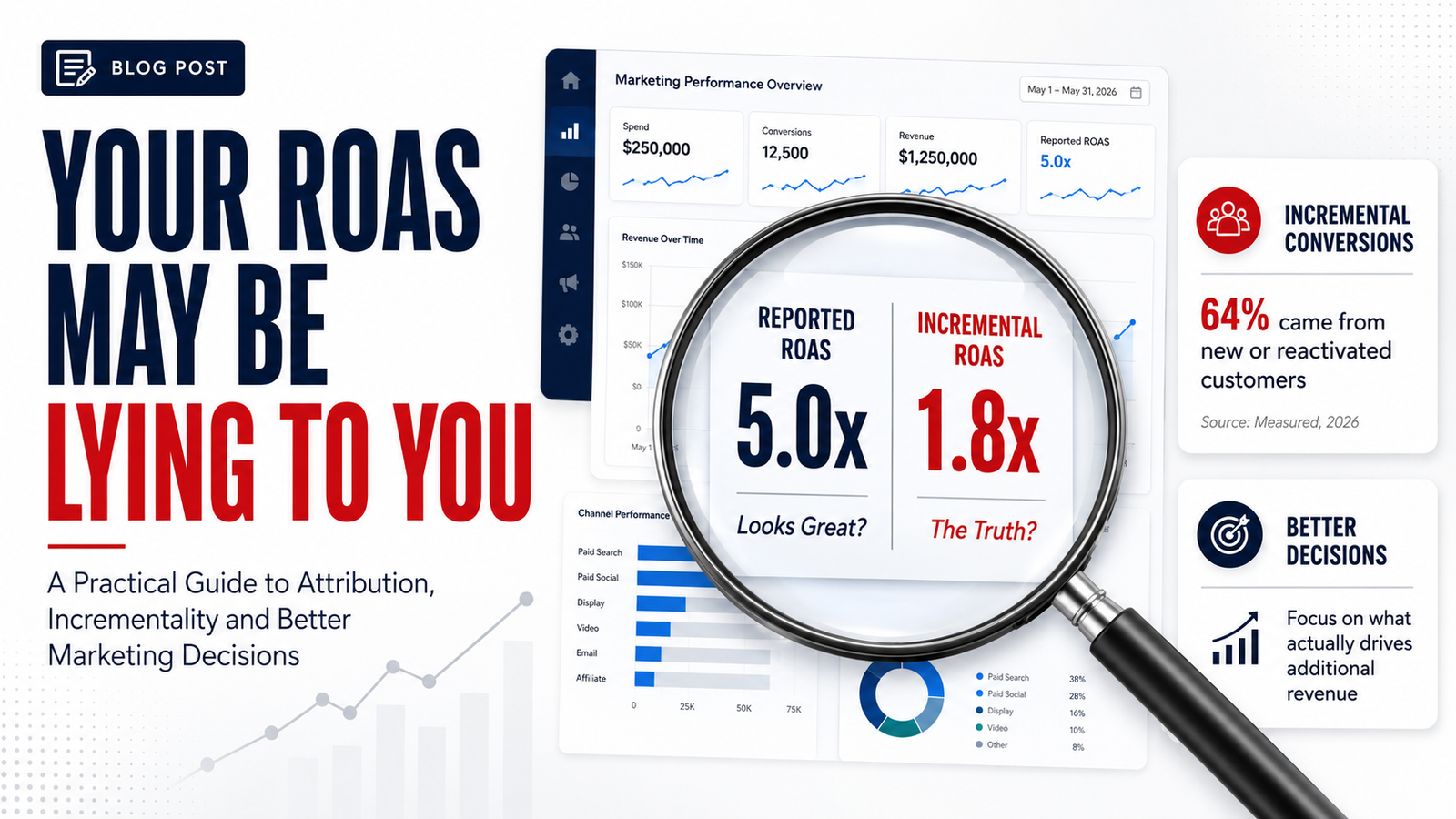
A 5X ROAS looks impressive on a dashboard.
But there is a question every performance marketer should ask before celebrating: how much of that revenue happened because of the advertising, and how much would have happened anyway?
That question is the difference between attribution and incrementality.
For years, marketers have been trained to optimize what platforms report. That made sense when the alternative was limited data and slow analysis. Today we have better tools, better experiments and more reasons to be skeptical of any system that grades its own homework.
ROAS is not useless. It is incomplete.
Table of Contents
Attribution answers who gets credit
Attribution is an accounting system. It assigns a conversion to a channel or touchpoint based on a rule.
A user clicks a Meta ad, returns later through Google, and purchases. Which channel gets the sale? The answer depends on the attribution model. Last click, data-driven attribution, view-through attribution and platform attribution can all tell different versions of the same journey.
The problem is that credit is not the same as causality.
A customer may already know the brand. They may have been planning to buy. A retargeting ad may appear just before purchase and claim the conversion even though it had little influence on the decision.
This is especially important for branded search, retargeting and high-intent audiences. Those channels often look efficient because they are close to the sale.
Incrementality asks a harder question
Incrementality asks: what happened because we ran the marketing that would not have happened without it?
The cleanest version compares an exposed group with a similar control group that does not receive the advertising. The difference between the two outcomes is the incremental lift.
This is much closer to the question a CFO or business owner actually cares about.
If I spend another $100,000, how much additional revenue or profit does the business create?
Why this matters more in an automated advertising environment
Modern ad platforms are very good at predicting who is likely to convert. That creates a measurement challenge.
If an algorithm repeatedly finds people who were already likely to buy, platform ROAS can look excellent while the incremental value is much lower.
Measured published a 2026 analysis covering more than 10,000 campaigns across more than 200 North American advertisers. It reported a median incremental ROAS of $2.16 for Meta and found that 64% of Meta’s incremental conversions in the study came from new or reactivated customers. The study also reported that Meta’s iROAS on new-customer KPIs was 2.3 times higher than Search.
Those numbers should not be treated as universal benchmarks for every business. The important lesson is that the study measured causal lift rather than relying only on platform-reported conversions.
Haus reached a similarly important conclusion in July 2026. In its more recent controlled experiments, campaigns optimized toward Meta’s Incremental Attribution setting produced higher experiment-verified incremental return than standard attribution in the typical test. Haus also cautioned that the result varied by business model and should continue to be tested.
Meta itself says its incremental attribution product is gaining traction. In its January 2026 update, Meta reported that a Q4 model rollout produced 24% more incremental conversions than its standard attribution model.
When a platform, an independent measurement company and an experimentation provider are all talking more seriously about incrementality, marketers should pay attention.
A simple example: the retargeting trap
Suppose an ecommerce company spends $10,000 on retargeting and the platform reports $60,000 in revenue. The dashboard shows a 6X ROAS.
That looks excellent.
Now imagine a holdout test shows that customers who did not receive the retargeting ads still generated $50,000 in comparable revenue. The actual incremental revenue associated with the ads is closer to $10,000.
The campaign was not necessarily a failure. It may have accelerated purchases, improved timing or helped some customers convert. But the 6X platform ROAS gave a very different impression of the campaign’s economic value.
This is why senior performance marketing decisions should not rely on a single dashboard.
The measurement hierarchy I prefer
Different tools answer different questions. I find it useful to separate them into four layers.
The mistake is not using platform metrics. The mistake is asking platform metrics to answer a question they were not designed to answer.
Five situations where I would question reported ROAS
None of these proves that attribution is wrong. They are signals that the marketer should investigate further.
Do not replace one misleading metric with another
The conversation moves from ‘Which campaign has the highest ROAS?’ to better questions.
There is also a danger in treating incrementality as a magic answer.
Experiments can be noisy. Markets are different. Seasonality matters. Holdouts can be contaminated. Small samples can produce unstable results. A test that works for a large DTC brand may not be practical for a smaller local business.
The right approach is to combine evidence.
Use platform reporting to operate quickly. Use analytics to understand the journey. Use experiments when the decision is important enough to justify them. Use finance metrics to decide whether the result deserves more capital.
What changes when marketers think this way
These questions are harder. They are also much closer to how a business should allocate money.
A performance marketer should not be paid to make the dashboard look good. The job is to help the business make better investment decisions.
That is why I still use ROAS, but I do not worship it. It is one signal in a larger measurement system.
The goal is not perfect attribution. Perfect attribution probably does not exist. The goal is enough evidence to make a better decision than the one you would make by trusting a single number.
Sources worth linking
These are deliberate outbound links. They support factual claims and improve the reader’s ability to verify or explore the topic. I would keep these links in the published article.