Every major advertising platform is working to make campaign execution easier.
That should make performance marketers slightly uncomfortable.
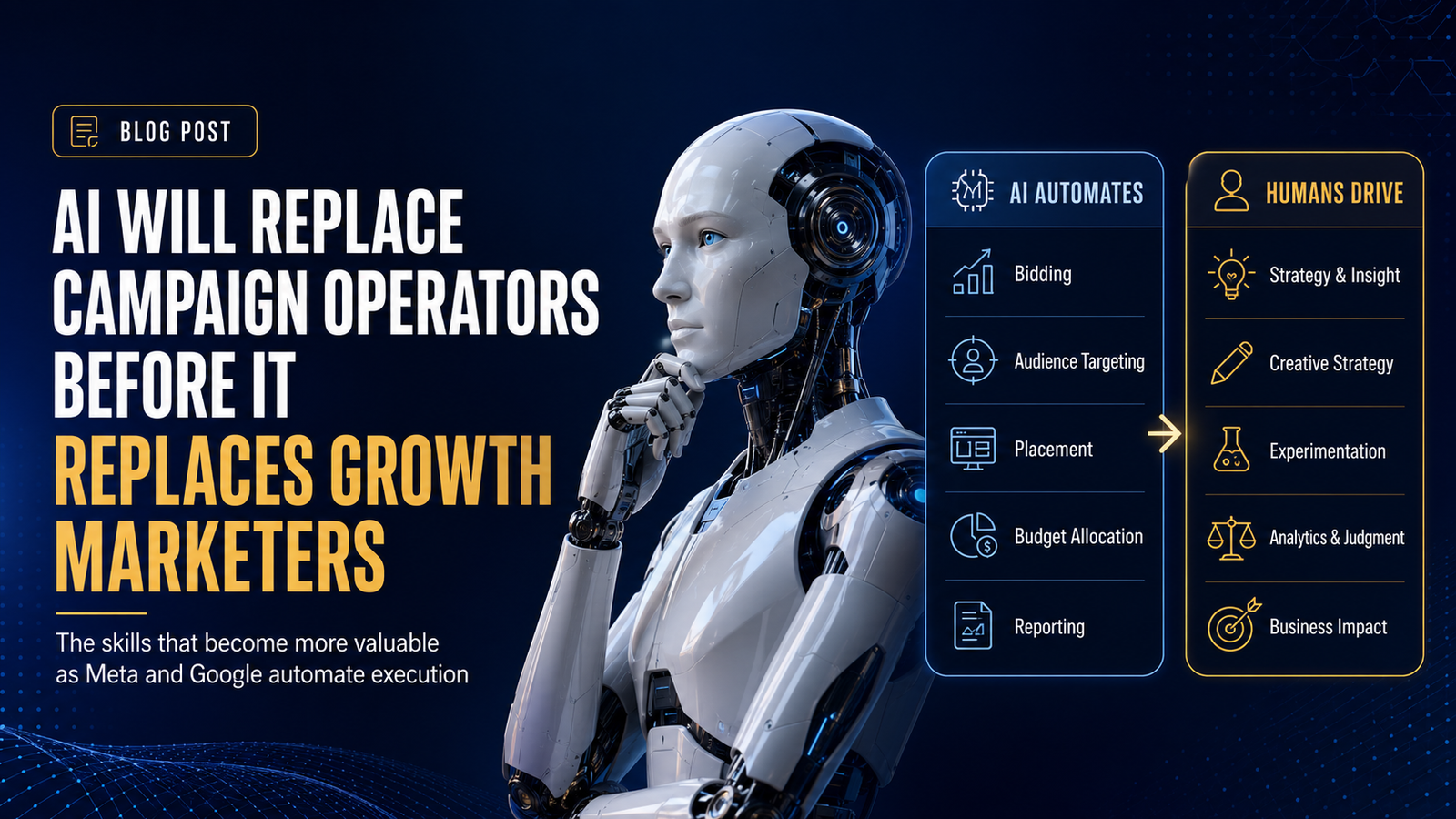
For years, a meaningful part of the profession’s value came from knowing how to operate complex systems. Campaign structures, bid strategies, audience configurations, keyword management, placement choices and reporting all required platform knowledge.
Much of that knowledge still matters. But the platforms are absorbing more of the execution.
The marketer whose value is knowing which buttons to click is vulnerable. The marketer who knows which problem to solve becomes more valuable.
Table of Contents
Look at what the platforms are building
Meta’s 2026 advertising update describes AI-assisted campaign optimization, AI-generated creative and more advanced ad-ranking systems. Meta says these systems are improving its ability to match ads with the people most likely to respond.
Google’s August 2026 AI Max update adds more automated planning and experimentation around budgets and ROI targets. This follows Google’s broader move toward AI-powered query matching, asset creation and campaign optimization.
The direction is clear. Platforms want fewer manual decisions and more high-level goals, creative inputs and conversion signals.
That does not eliminate marketing. It changes the job description.
The wrong response is to compete with the machine at execution
If AI can create twenty ad variants in minutes, the human advantage is not typing twenty-five.
If an algorithm can adjust bids thousands of times per day, the human advantage is not making one more bid adjustment.
If a reporting system can summarize yesterday’s results automatically, the human advantage is not creating another dashboard.
The durable work sits above those tasks.
What is the real growth constraint? Which customer segment is worth pursuing? What promise should the brand make? Which creative idea deserves investment? Is the conversion data trustworthy? What experiment would change our mind? Should the business scale this channel, or is the apparent performance simply attribution noise?
Those are judgment problems.
Marketers are using AI more often than they are using it well
CXL’s 2026 AI maturity benchmark found that 57% of assessed marketers were still at an AI-assisted stage, 34% were AI-integrated and only 9% reached what CXL classified as AI-native.
The most interesting part of the benchmark is where the weaknesses appeared. Production was further ahead, while analytics and operations were among the least mature areas.
That makes sense. Generating content with AI is easy to demonstrate. Building a reliable measurement workflow, connecting systems, defining metrics and making decisions from imperfect data is much harder.
Those harder areas are also where experienced growth marketers can create an advantage.
Five skills I expect to become more valuable
AI actually increases the importance of CRO
There is a reason I believe conversion optimization becomes more valuable, not less, as acquisition platforms automate.
When traffic acquisition becomes easier, more businesses can buy competent traffic. The competitive advantage shifts to what happens after the traffic arrives.
If one company converts a landing page at 2% and another converts at 4%, the second company can afford to pay much more for the same audience.
AI may help generate the page or produce headline options. It does not remove the need to understand the visitor’s motivation, anxiety, objections and decision process.
In other words, automation can make execution faster. It cannot make a weak value proposition strong by itself.
The performance marketer becomes an orchestrator
McKinsey’s 2026 research on the agentic advertising economy found that nearly three-quarters of surveyed advertisers expected AI to increase total media spend, and roughly one-third expected AI to improve ROAS by more than 10%.
If those expectations are even partly correct, performance teams will manage more spend through systems that make more decisions automatically.
That makes orchestration more important.
The marketer has to make sure the right customer insight reaches the creative team, the right conversion events reach the platform, the right landing page supports the ad, the right CRM workflow handles the lead, and the right business metric is used to judge success.
That is not a smaller job than media buying. It is a broader one.
What I would learn today if I were entering performance marketing
I would still learn Meta Ads, Google Ads and the fundamentals of paid acquisition. You need to understand how the systems behave before you can supervise them intelligently.
But I would not build my entire career around platform mechanics.
- Learn customer research and copy fundamentals.
- Learn how a landing page converts and why users abandon it.
- Learn GA4, tagging and basic data quality.
- Learn A/B testing and the limits of experiments.
- Learn unit economics, CAC, margin, LTV and payback.
- Learn how CRM and lifecycle marketing affect the value of a lead.
- Learn enough AI workflow design to automate repetitive analysis and production without outsourcing your judgment.
Those skills make you useful even when the interface changes.
A 90-day AI adaptation plan for experienced marketers
For experienced marketers who already understand growth, I would approach AI adoption in three stages.
The goal is not to use more AI. The goal is to shorten the distance between evidence and action.
The profession is not disappearing
I do not believe performance marketing is disappearing. I do believe a certain version of the job is.
The operator who mainly builds campaigns, exports reports and makes routine adjustments will face more automation every year.
The growth marketer who combines acquisition, customer psychology, conversion, measurement and commercial judgment will become more difficult to replace.
AI will make marketing execution cheaper. It will make good judgment more valuable.
That is the opportunity. Do not compete with the platforms at what they are designed to automate. Move toward the decisions they still need humans to make.
Sources worth linking
These are deliberate outbound links. They support factual claims and improve the reader’s ability to verify or explore the topic. I would keep these links in the published article.